|
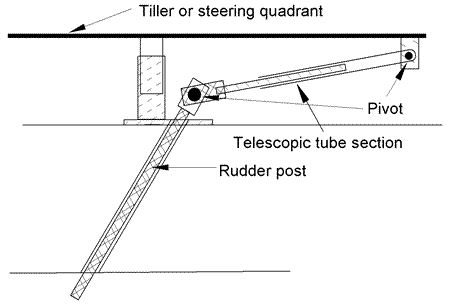
Many traditional hull designs have a steeply raked rudder and this
can cause trouble when connecting a steering arm, whether vane or radio.
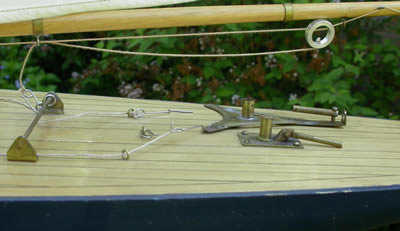
I saw this neat solution to the problem on Xmuna and the construction
is clearly shown in the picture and diagram. The material is brass with
steel pivot pins and the parts are simply soft soldered together.
Following a number of requests we will soon have
basic designs here for self steering grear.
This is an extract rfrom a recent discussion on the MSN
Group Vintage Model Yachts
From Earl Boebert USVMYG:
What you want is called "long staple down cambric." "Long
staple" refers to the kind of cotton it is. You will also find
called "Egyptian" or "Sea Island" cotton. The latter
is very chichi and very, very expensive.
"Down" in "down cambric" is "down" as
in "down pillow," that is, bird feathers. Down cambric is
very tightly woven to keep the feathers from poking through. It is sold
to quilters and is best obtained by going to a quilters convention,
where specialty mills often show up.
The big problem with cotton sails is getting a material that will hold
a sewn seam under strain. Luckily, one can now use the heat-setting
adhesive to make the seams with the sewing added later for appearance.
The best heat-setting tape I have found (in the US) is sold by the kite
supplier "Hang-Em-High." This is a 3M industrial product that
they slit down to 1/4 inch and it sticks to cotton like crazy, plus
is so waterproof that it survives a bout in the washing machine
From Russell Potts. VMYG:
Ralph's book, 'Ralph's Guide to Vintage Sailmaking: Cotton sails for
Older Styles of Model Yacht', is published by the Curved Air Press,
a micro publisher that I run.
As the publisher, (and part author- there is some stuff at the end about
making sails without sewing, which I contributed), obviously I'm biassed,
but I believe that it is the best treatment of this slippery art so
far produced, certainly better than anything published when cotton was
the material of choice for model yacht sails. I can supply for the cover
price of UKP 8.00, plus 1.00 postageand packing in the UK. Overseas
orders will cost more to ship, but I only charge actual cost.Payment
by Sterling cheque or via PayPal.
Turning to the practical question raised, the most appropriate material
we have found in the UK is down proof cambric, used for lining cushions
to stop the feathers coming out. It comes in various weights and a small
range of cream and off-white colours. The one the Vintage Group in the
UK prefers comes from stores in the John Lewis Group and is 'downproof
cambric 31805'. Go to the furnishing and upholstery department, not
the dress fabrics section.
|